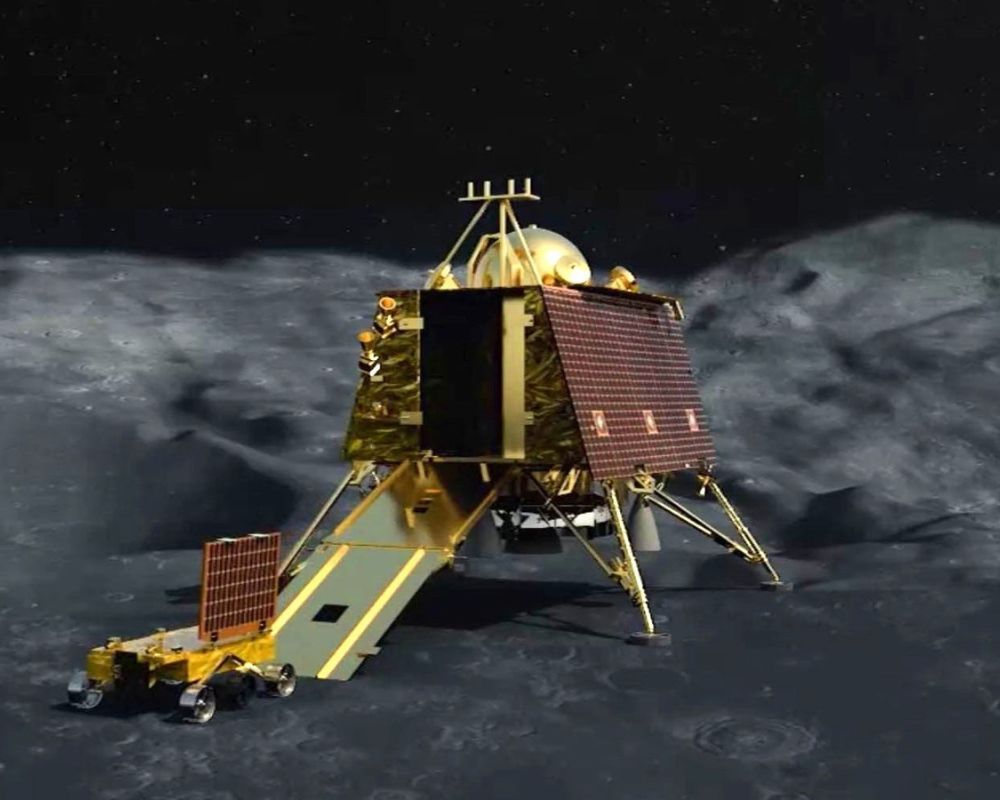
Chandrayaan-3’s lunar landing is particularly sweet to savour because it came on the back of years of debilitating sanctions, hard work by ISRO scientists, unstinted political backing, and the heartbreak of failures. CH-3’s success symbolises the spirit of India to endeavour together for greater glories in the years ahead
The successful landing of Chandrayaan-3 (CH-3) once again impressed this fact on the world and reaffirmed the importance of the Do-It-Yourself attitude for India.
The Indian Space Research Organisation (ISRO) has fulfilled the prayers of more than a billion hearts. This success did not come overnight but through the trials and tribulations of India’s scientists and political leaders over the past few decades.
India always demonstrated greater resilience in the face of technology denials and failing partnerships and emerged higher and better placed in the international community. The successful landing of Chandrayaan-3 (CH-3) once again impressed this fact on the world and reaffirmed the importance of the Do-It-Yourself attitude for India.
Learnings From CH-2
One clearly remembers the emotionally charged day in September 2019 when India first tried landing on the moon but failed. The Chandrayaan-2 (CH-2) mission was originally planned as a joint project with Russia. But the failure of Russia’s Phobos-Grunt mission to Mars severely delayed its contribution of the lander to the CH-2 mission.
Even though ISRO has realigned the project schedule and built a lander by itself, these efforts could not materialise in a landing. What followed was a precise and extensive critique of the CH-2 mission by ISRO scientists, leading to the adoption of the failure-based strategy proven successfully today.
Thorough “failure analysis” has become the springboard for ISRO to recover from losses and provided India with a range of launch options. This process was put to maximum testing during the mastering of cryogenic engine technology, which once triggered technology sanctions on India and denied access to machine parts crucial for its space programme.
Sanctions: The Long Struggle
ISRO has struggled for about two decades to build its expertise on this technology. The GSLV Mk II was essentially used as a test bed for this purpose, which explains its low success rate.
Meanwhile, New Delhi has revamped its political relations with the United States that resulted in ISRO centres being removed from the American government’s sanctioned entity list. The grit and dogged determination pursued by the top scientists, diplomats and political leaders to safely navigate India during these tumultuous years turned the sanctions setback into a true “blessing in disguise” for the country.
Today, a higher thrust version of this engine powers the LVM-3 rocket that had put the Vikram lander on its course to the moon. A semi-cryogenic engine is also being developed as the first stage of more powerful future launch vehicles.
ISRO’s A-Game Coming
Moreover, the LVM-3 is also undergoing development to become a safer and reliable rocket to launch the Gaganyaan missions. In fact, ISRO has tested some of the elements to be used in the human-rated LVM-3 (HLVM-3) onboard the rocket used for CH-3 launch. There is no doubt that the ambitious Gaganyaan mission will also achieve success upon India’s own efforts as technology development accelerates following mastering the fundamentals.
This principle also supported standing up the PSLV as one of the most successful launch vehicles in the world. Its customers include the Western countries, some of which supported sanctions on India earlier. The industrialisation of PSLV and the commissioning of the Small Satellite Launch Vehicle (SSLV) will boost India’s competitiveness in the global small satellite launch market.
The structure of the Indian space programme has also been reorganised to enable access to ISRO facilities for the private space startups to test their technologies. These developments will free ISRO from the routine development and launch of satellites. The scientific workforce will be better utilised to develop more critical technologies and products.
What Next Team India?
There is no doubt that the Indian space programme is on the cusp of a new growth phase, mutually supported by the growing economy and diplomatic clout of the country. The national interests have expanded from the sub-continent to the south pole of the moon and India needs a new generation of scientists and thought leaders to take charge.
One must not expect though that the setbacks have ceased. In fact, the follow-on missions will be more challenging and come with their own set of complexities. The lunar sample return mission, which must be undertaken in the coming years, is one example.
At the same time, India should not lose focus on building basic infrastructure to become completely self-reliant in launching the heavier communications satellites and developing an array of space services that benefit the common citizens.
The restrictive policies of the yesteryears are being discarded in favour of entrepreneurs building these services. This is expected to gain further pace.
It is heartening to witness the scientists and engineers responsible for these endeavours being educated and trained for the better part in the country itself. The ISRO is a prime example of this.
It is also welcoming that the country no longer subjects this organisation to undue criticism as largely witnessed in the past. It shared the regret and the sorrow of the former ISRO chairman when the CH-2 failed and now stands ready to inculcate the success of the CH-3 mission in other domains.
Source: https://shorturl.at/dkBRV