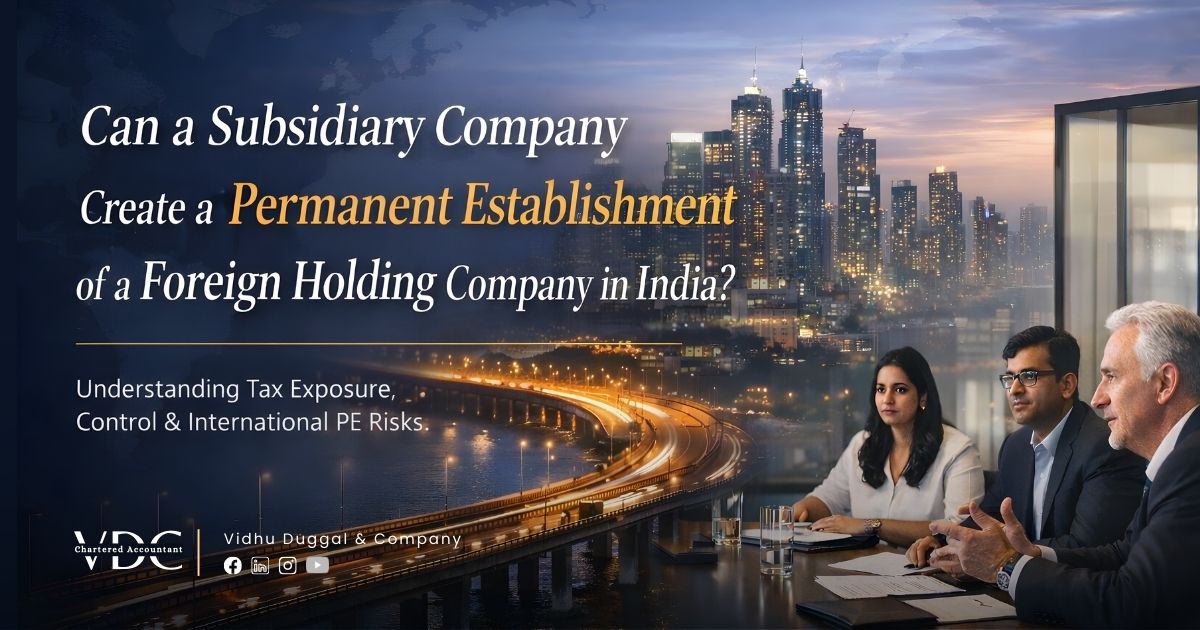
In normal scenarios, Subsidiary & foreign Companies are separate legal entities.
Indian Subsidiary Company is separate from foreign Holding Company. However in certain scenarios, the functions performed by the Subsidiary Company for Foreign Company can create PE of Foreign Company in India.
Therefore, it is important to check the PE test as mentioned in Article 5 of UN Model & most of the DTAAs India entered with.
Let us understand with an example: Suppose BNM Singapore is a holding Company of BNM India. BNM Singapore was engaged in the business of providing financial advisory services, corporate lending & Security underwriting services.
Further, BNM India was incorporated to support BNM Singapore in front office in their overall worldwide operations. BNM India entered into agreement with BNM Singapore to provide various back office & support functions such as equity & data processing, IT enabled services etc.
BNM India used the logo & Brand name of BNM Singapore. Further, BNM Singapore provided customer material, hardware, IRP & other rights. BNM India followed TNMM method as per Transfer pricing regulations where BNM India raises a monthly invoice for monthly costs plus a mark-up of 15% to BNM Singapore.
Article 5(1) of DTAA
In the given scenario, first we need to check Article 5(1) of the DTAA to check the PE status
As per Article 5(1) of the DTAA, a PE of a multinational enterprise would come into existence in India, only if a fixed place exists in India, through which the business of the multinational enterprise (BNM) was wholly or partly carried on.
First Part of Article 5(1) emphasizes on fixed place of business & Second part of Article 5(1) states that the business should be carried on wholly or partly through such fixed place.
It is to be noted that BNM India was engaged in supporting the front office functions & providing IT enabled services. It means back office functions has been outsourced by BNM Singapore to BNM India. For BNM Singapore, front office functions are major part of its business. However, in the given case BNM Singapore has outsourced back office functions only to BNM India, which does not constitute its major business.
If BNM Singapore has outsourced some major & substantive functions to BNM India relating to front office. Then, it can be said to be PE of foreign Company in India.
Since, BNM Singapore was not carrying out any business activity in India. BNM India was rendering back office operations in India and such functions are to be considered as 'preparatory and auxiliary' in nature within the meaning of Article 5(7) of the UN Model. Hence, no fixed place of business was constituted under Article 5(1).
Article 5(2) of the DTAA
Now check the Article 5(2) of the DTAA to check the PE.
It is read as follows:
The term Permanent Establishment’ includes:
- Place of Management
- Branch
- Office
- Factory
- Workshop
- Mine
- Oil or gas well
Article 5(2) list is inclusive.
In the given case, BNM Singapore does not have any of the above in India. Therefore, BNM Singapore does not have PE in India as per Article 5(2).
Service PE as per Article 5(3) of the DTAA
The term PE also encompasses:
- A building site, a construction, assembly or installation or supervisory activities in connection therewith only if lasts for more than 6 months or,
- Furnishing of services through employees only if the employees stayed for a period more than 6 months in 12 months period.
In the given case, employees of BNM Singapore have not visited India. Therefore, Service PE is not formed by BNM Singapore in India.
Agency PE under Article 5(4) and Article 5(7) of the DTAA
Both the articles relates to Agency PE.
Article 5(5) & Article 5(7), a PE is constituted for another person if the following conditions are satisfied:
- There is a person
- He is acting on behalf of an enterprise
- He is acting in the state of source
- He is not an independent agent to whom Article 5(7) applies
BNM India had no authority to enter into or conclude contracts on behalf of BNM Singapore and the contracts would be concluded only in the Singapore. The implementation of the contracts only to the extent of back office functions would be carried out in India. As a consequence, BNM India would not constitute an agency PE in India under Article 5(4) of the DTAA.
However, if in the given case, BNM India had been given an authority to conclude contracts on behalf of BNM Singapore, then in such a case BNM Singapore would have constituted PE under this Article.
Conclusion:
BNM Singapore does not constitute PE under the Article 5 of the UN Model.
Further, it can be concluded that functions performed by the Subsidiary Company plays an important role in determining the PE of foreign holding Company in India.
It cannot be straight away said that Subsidiary Company constitutes PE of foreign Company in India.
It has to pass through all the above checks to determine the PE status of foreign Company in India.
CA Vidhu Duggal
#foreigncompany #holding #subsidiary #IT #backoffice #internationaltax #transferprice #DTAA #treaty #US #europe #PE #business #Singapre #Australia #Agency #services #CAVidhuDuggal #VDC #VidhuDuggalandCompany