
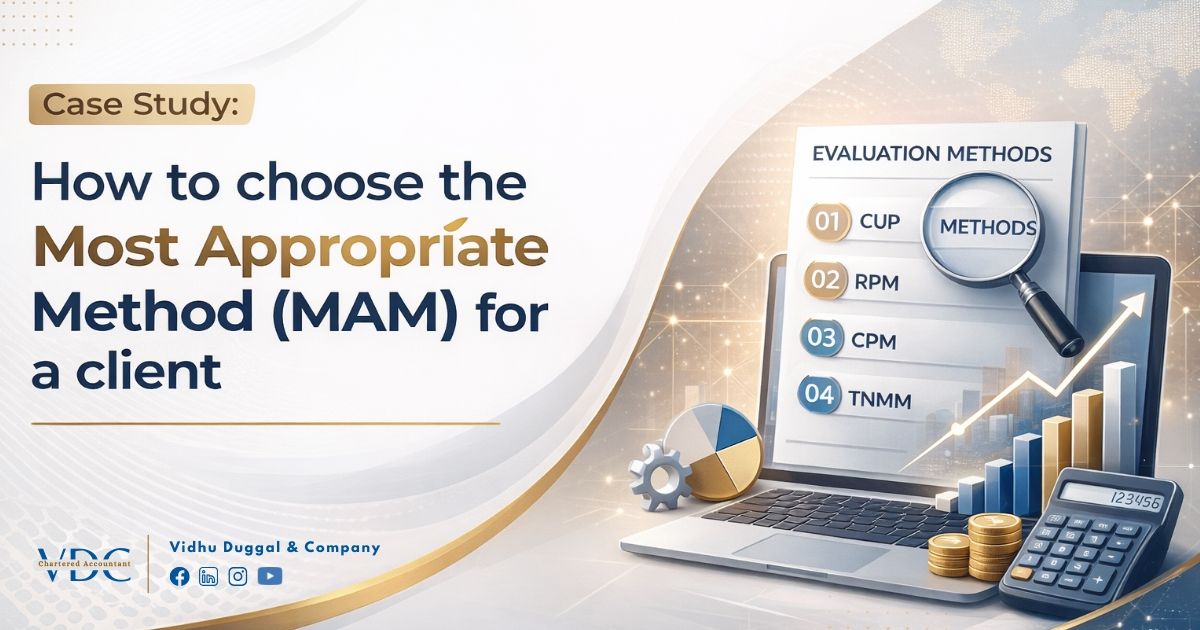
A client from Germany approached us to choose the Most Appropriate Method (MAM) of Transfer Pricing method applied on its transactions with Indian Subsidiary Company.
Background of the case:
GNC Germany is in the business of supplying electronic Components. Inc. India, Subsidiary of GMC Germany, assembles the electronic components in India & sells to third party customers in India.
Factors to be considered while selecting the MAM
- Nature & Class of Transactions.
- Class of AEs entering into the transaction.
- Functions performed by them taking into account assets employed or to be employed & risks assumed.
- Availability, coverage & reliability of data necessary.
- Degree of Comparability.
- Extent to which reliable & accurate adjustments can be made.
- Nature, extent & reliability of assumptions required to be made.
FAR analysis of transactions
1) Functions performed
- GNC Germany
- Research & development
- Manufacturing
- Strategic decision making - INC India
- Assembly of finished goods
- Distribution to end customers
- Routine activities
2) Assets Employed
- GNC Germany
- Ownership of valuable intangibles (patents, trademarks) - INC India
- No ownership of Intangibles
3) Risks Assumed
- GNC Germany
- R&D risk
- Product liability risk
- Market risk - INC India
- Inventory risk
- Operational risk
4) Characterization
GNC Germany- Principal entity
INC India-Routine manufacturer
Evaluation of Transfer Pricing Methods
1) Comparable Uncontrolled Price (CUP) Method This is most appropriate when one of the AEs entered into same truncation with an independent enterprise as well.
In the given case, there is no external comparable available in the given case.
2) Resale price Method (RPM)
- This is the most appropriate method where transactions involve purchase & resale of property in which reseller does not add any substantial value to goods.
- In the given case, INC India is adding substantial value by performing assembly function. This method is also not applicable.
3) Cost Plus method (CPM)
CPM Can be considered most appropriate method in the following scenarios:
- For transfer of semi-finished goods between entities
- Transactions involving a contract manufacturer
- For Intra group provision of services
In the given case, above services are not provide by INC India to GNC Germany, therefore this method is also not applicable
4) Transactional Net Margin Method (TNMM)
TNMM is considered as most appropriate method when one party performs routine functions
In the given case, INC India performs routing functions for GNC Germany. Further Net margin Comparable are also available. Therefore TNMM Method can be chosen as the most appropriate method in the given case.
5) Profit Split Method (PSM)
This is the most appropriate method where transactions are complex involving the use of intangible & transactions are so interrelated that they cannot be evaluated separately. This is not applicable in our case.
Selection of Tested party
In the given case, INC India is the least complex party & its comparable are also available to determine the Arm’s Length Price (ALP).
Conclusion
TNMM is the most appropriate method out of all the Transfer Pricing methods based on the FAR analysis, Nature of transaction & reliability of data available .Further, INC India shall be chosen as the tested party.