Case Overview
In this case:
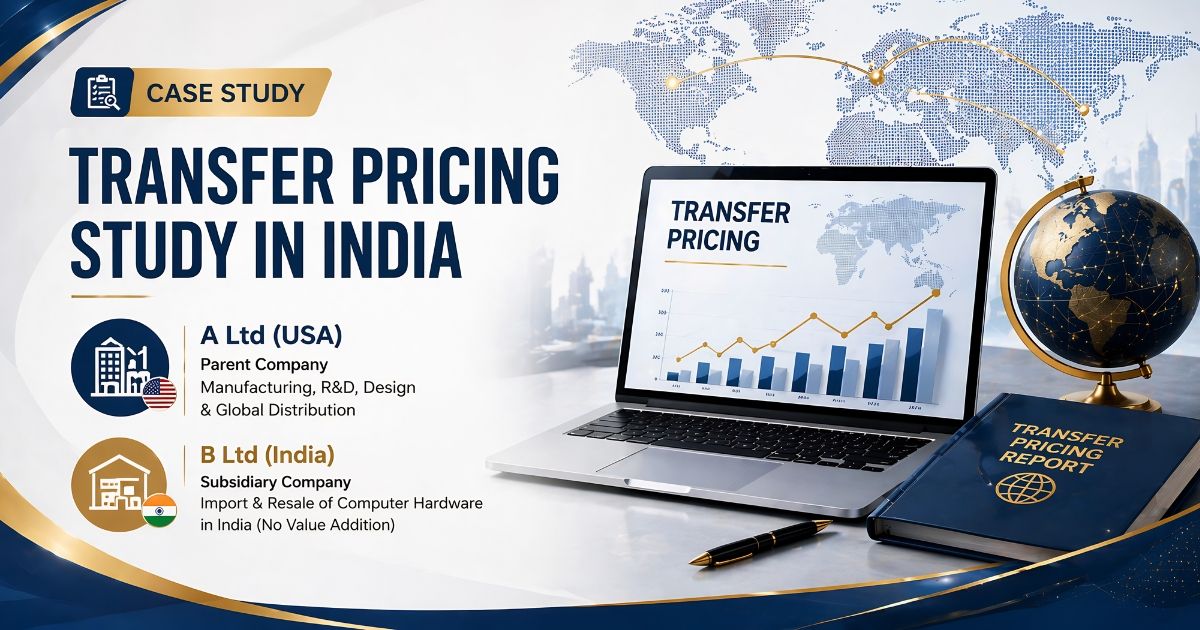
- A Ltd (USA) – Parent company engaged in manufacturing, R&D, design, and global distribution of computer hardware
- B Ltd (India) – Subsidiary importing and reselling hardware in India without value addition.
B Ltd operates as a distributor, maintaining warehouses and selling products in the Indian market.
Now B Ltd has approached us to prepare the Transfer Pricing Report to ensure the transactions are entered at Arm’s Length Price. B Ltd wants to understand the contents of Transfer pricing report & how will we evaluate the ALP of the transaction.
Structure of TP Study
1) Executive Summary
2) Group Overview
3) Industry Overview
4) Functional analysis
5) Selection of Tested Party
6) Selection of the most appropriate method (MAM)
7) Economic analysis
8) Conclusion
9) Appendices
1) Executive Summary
Summary captures high level analysis of the entire TP study & summarizes the results of benchmarking analysis performed to determine the ALP of the international transaction undertaken during the relevant period.
2) Group Overview
It gives a brief description of the Group’s as well as the taxpayers business operations.
This section enables the management as well as tax authority to identify international transactions.
Key points to be included in this section are:
1) Brief description of the Group
2) Description of the nature of business
3) Details of AE with whom transactions have been entered
4) Turnover of the group etc.
3) Industry Overview
- It means giving a broad description of the industry in which it operates. Following points should be kept in mind while preparing industry overview:
- Provide a brief overview of the global scenario & then follow it up with conditions prevailing in Indian Industry.
- Mention the source from where it is obtained.
- Contradictory statements should be avoided
4) Functional analysis
Key points to be considered while undertaking FAR analysis for preparation of Transfer Pricing report:
- Which entity is responsible for R &D & Product development?
- Which entity is taking decisions to purchase finished goods, inventory & management?
- Which entity holds inventory & computer hardware based on orders?
- Which entity incurs marketing expenditure for creating its own market
Functions performed should include the entire value chain involved in international transaction pertaining to import of computer hardware by B Ltd from A ltd.
FAR analysis of TP study of B Ltd.
Functions performed
A Ltd performs following functions:
1) R&D, design & upgradation of product
2) Purchase of components of hardware
3) Assembly & packing of Hardware products
4) Distribution of Hardware products as per demand of geographies
B Ltd performs following functions:
1) Distribution & storage of hardware in India
2) Ensuring sale in India
Assets Employed
A Ltd employs following assets:
1) Assembly units, warehouses in US
2) Assembly plants in US
B Ltd employs following assets:
1) Distribution warehouses in India
Risks assumed
A Ltd assumes following major risks:
1) Market risk involving competition & product pricing
2) Technology risk
3) Product liability risk
4) Supply Chain risk
5) Manpower risk
B Ltd assumes following major risk:
1) Supply Chain risk
2) Credit Risk
3) Foreign exchange risk
4) Manpower risk
5) Selection of Tested Party
Tested party should be such which is the most reliable & for which most comparables can be found. It means with less complex functional analysis In our Case, B Ltd can be chosen as the tested party where comparables can be easily found & it is the least complex.
6) Selection of most Appropriate Method ( MAM)
There are 6 methods prescribed under TP regulations:
1) CUP method
2) RPM
3) CPM
4) PSM
5) TNMM
6) Other method
In our case, Resale price Method (RPM) can chosen as the most Appropriate Method. In this case, B Ltd is not adding any value to the hardware product. IB Ltd is charging its margin on the purchase price & reselling to end customers in India. Therefore, RPM is the most Appropriate Method out of all for the client.
7) Economic analysis
It means analyzing or comparing the trsanfer price i.e. price set in controlled environment with that of uncontrolled environment.
This would involve the following:
1) Application of MAM
2) Search for uncontrolled comparable transactions & determination of ALP
8) Conclusion
The conclusion section of TP study captures high level summary of the study, primary including
the transactions involved, most appropriate method & results of the benchmarking analysis.
9) Appendices
At the end of the report, following could be annexed as appendices:
1) Abbreviations
2) Indian TP regulations
3) Details of International transaction
4) Details of databases
5) Business description of comparables
6) Segmented Financial information
Final Conclusion on TP Report of B Ltd:
Based on the FAR analysis, B Ltd is characterized as a limited-risk distributor, while A Ltd performs complex functions and assumes significant risks. The Resale Price Method (RPM) is identified as the Most Appropriate Method due to the nature of B Ltd’s operations.
The benchmarking analysis indicates that B Ltd’s margins are consistent with comparable independent distributors. Therefore, the international transactions between A Ltd and B Ltd are at arm’s length and comply with transfer pricing regulations.
www.vidhuduggalandco.com | vidhu@vidhuduggalandco.com | Profile
#Transferpricing #india #FAR #FAR #internationaltransaction #foreigncompany #subsidiary #branch #MAM #PSM #RPM #CUP #comparables #ALP #CAVidhuDuggal